
It’s new release Tuesday, and I’m excited to dive into Olga Ravn’s new book The Wax Child. I loved her weird and wonderful experimental science fiction novel The Employees, so I’m excited to read her take on witches.
There’s an article making the rounds about publishing’s “gambling problem.” The general thesis is that publishing houses place their biggest bets on debut authors and don’t spend enough time developing authors if they don’t “break out” financially with their debut. It’s a fascinating look at the (frequently frustrating) inner workings of the publishing industry.
After that, I read Lincoln Michel’s post on the Book Club Industrial Complex, which talks about the outsize influence and flattening effects that celebrity book clubs have on the publishing industry.
These two pieces read in tandem made me think about my own role in an industry that seems opaque to outsiders or newcomers.
As far as the publishing industry goes, I am not a very important cog. I am a buyer for a mid-size independent bookstore. My store accounts for a tiny fraction of a fraction of their business. But I am a cog. I am the last piece of the book industry puzzle before a book makes it into a customer’s hands. I am the final gatekeeper, at least in my own store. I am not particularly powerful—I don’t buy for a large national account like Target or Barnes and Noble—but I do have more power than people outside of the industry.
As a buyer, I make all the decisions about frontlist (forthcoming) books, starting with whether or not we will stock the book to how many copies we will get to whether the book will be displayed in a prominent place at the store.
To make these decisions, I consider a range of factors: my bookstore’s personality, my own instincts and preferences, the publisher’s marketing information, the sales rep’s opinion, and sales data like comps and the author’s sales track record. Sales track is important, but it is never my only factor.
How do I buy the books?
Bookstores used to decide what books to get by looking through actual, physical catalogs and filling out order sheets by hand. A publisher’s sales representative would send catalogs to the store owner or buyer a few weeks or months in advance of their meeting with the buyer, and the buyer would read and mark the catalogs to create an order. I hear nostalgic stories about this time fairly frequently. Most sales representatives still remember it with a kind of wistful nostalgic horror. The buyer who trained me used to buy this way.
As you can imagine, this was a system that was begging for an online solution once computers became ubiquitous. In 2002, a man named John Rubin invented the software known as Edelweiss. His mother owned a bookshop, and he had witnessed her managing the time-intensive and laborious process of buying books for years. It’s honestly a fascinating story. You can read more about it here.
Once independent bookshops (and publishers) embraced the software, (which took more than a few years…small businesses tend to be risk-averse and slow to adopt technology) the modern book-buying process that I follow was born. Now, almost all buying is done on this software platform. Publishers upload their catalogs of forthcoming books to the platform. Sales representatives add confidential notes for buyers, known as “markups.” Buyers look through the catalogs and markups and make purchasing decisions right there on the platform, creating an order as they go through each catalog.
Edelweiss gives me all the relevant information I need to make purchasing decisions, including pulling our own store’s sales data into the platform to provide me with up to date information.
Just to give you an idea of the scale of the task of buying: I have about 40 different catalogs on my Edelweiss worklist right now as I start next season’s buy (books coming out in the Winter/Spring of 2026). There are over 14K individual titles in these catalogs combined. I’ll see similar numbers when I buy for the summer, and a bit more when I buy for fall, meaning I see between 40 and 50K individual book titles every year. New books, not backlist. I have to look at each one and determine if we will or won’t carry it. For some titles that’s easy. We have a manga section that is a single shelf, approximately two feet across, so I buy extremely limited quantities. It’s pretty easy to skip past Reincarnated into a Game as the Hero’s Friend: Running the Kingdom Behind the Scenes (Light Novel) Vol. 5. I make that decision in the microseconds it takes me to scroll past it on the catalog. But most decisions take me anywhere from 30 seconds to a minute. I have to synthesize as much information as possible in that time and move on to the next title, otherwise my work would take me far too long. For example, right now I am buying a winter catalog for one of the big five publishers. There are over 1000 titles. If I consider each title for a full minute, that’s about 16 hours of work. Imagine if I took two minutes on every title? My two days worth of work would suddenly be four. I don’t have four days to spend on each catalog. I have to make my decisions quickly. So how do I make those decisions?
Store Personality
Independent bookstores are as varied as the people who own them. Some stores are mission-driven, like Black, queer, feminist, or radical bookstores like Red Emma’s in Baltimore. I am a big fan of these, but my bookshop is not mission-driven. Our store aligns more with a second kind of model: what I think of as values-driven. We do not have a written mission, but we do have specific values for the store. Our store inventory generally leans politically to the left, as most independent bookshops do, and we buy widely and diversely from a broad range of publishers, including university presses, very small independent presses (like Deep Vellum, Charco Press, or Tilted Axis), mid-range respected independent publishers (like Graywolf and Norton), to the “Big Five” major publishers.
We stock a large number of queer, feminist, and radical books, but we will also order that annoying republican book if asked. We have only ever refused to order one book in the entirety of the store’s lifetime. In general we follow a kind of curatorial library model: we will order anything people ask for, but we curate what we carry. It sometimes happens that a book I don’t particularly care for personally will still be one that I buy for the store: it is not my preferences I buy for, but the store’s. This is always my first consideration. Regardless of sales track, we are never going to regularly stock a book that doesn’t align with our values. An example would be that weird anti-Anthony Fauci book that came out a few years ago. We had a couple of customers who ordered it, but we did not keep it on the shelves. But most books align with our store’s personality and values, so I have to consider a range of other factors.
Buyer’s Preference and Instinct
My own preference and gut instinct is actually one of the least important factors I consider, but it informs other decisions I make so I wanted to discuss it now. As a decision factor, instinct is the most fallible and the most prone to bias. For some reason, I’m almost always gonna buy a book with a rabbit on the cover, and I absolutely could not begin to guess what that’s about.
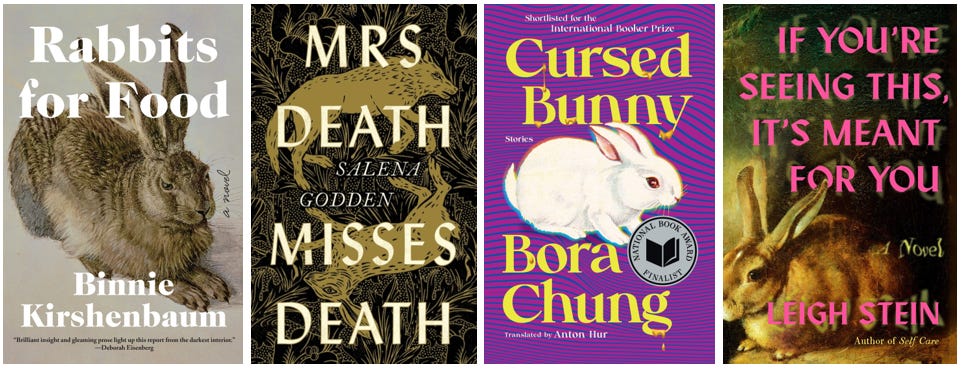
Sometimes my instinct is dead on. I knew Raising Hare was going to sell well, (not just because of the rabbit on the cover) even though other indicators for it were not great. It was a debut memoir by a British journalist about handraising a baby hare. Debuts are notoriously tricky. Memoirs even more so. But my instinct said: we haven’t had a big human/animal relationship book in a while, this one has a great cover, it’s written by a journalist so the writing will be good and she will have media connections…this one’s gonna hit. I bought it in display quantity. And sure enough, it made the ABA’s Indie bestseller list and we sold over 30 copies. Which might not sound like a huge number, but for a debut memoir at an indie bookstore? That’s very respectable.
My instinct has also steered me very wrong. I won’t name the books because that feels mean, but multiple times I’ve bought display quantities of fiction titles that I personally think will be really big sellers, and they have lingered, unsold for months, evidence of my shame. My point is that instinct is tricky and not always to be trusted. It’s where you make the riskiest bets as a buyer.
Where I let my preferences have more say is when I have actually read the book and I plan on featuring it as one of my staff picks. Our staff picks are featured in our social media as well as our website. Staff picks also get those little shelf-talkers that customers really love even though I think they look like so much clutter. The point is that staff recommendations sell books. So if I know I’m going to staff pick a book, I will buy more of it than I otherwise would.
Publisher information and the sales rep’s opinion
Another factor that carries significant weight in my decision making process is the sales rep’s “markup.” A markup contains publisher information that the sales rep shares only with buyers. Some of that information is private or temporarily confidential, such as print runs, whether or not the book has been picked by a major book club, and in some cases, what the book even is. Some books are sold to stores without a title or author listed in the public catalog, but the markup will tell me that it is a major celebrity’s memoir. The rep tells me this confidential information so I can make an informed buying decision, but they keep it secret until the marketing team announces it for ideal amounts of splash. I don’t pretend to understand how marketing works.
The markup also contains a one or two sentence summary of what the book is about, as well as any relevant information like media coverage that has already been lined up for the book. When I am looking at a new book in the catalog, the first thing I see besides the cover is the sales rep’s markups. I don’t even read the marketing copy summary, which is frequently too much information when I need to make my decisions within a minute. The best markups are short and keep information relevant to me.
(As with many pieces of the publishing puzzle, markups vary from publisher to publisher, and in most cases, from sales rep to sales rep. An experienced buyer will still know what to do with a poorly written markup, but not every buyer has the freedom or time to approach buying the way I do. Most buyers are also store owners (I am not), and they have to fit buying in with a million other tasks. Bad markups mean they might not buy as strategically or thoroughly. A book might get only 15 seconds of their time. Because that’s all they have.)
A large print run in the markup is an indicator of the publisher’s confidence in the book, which, in turn, gives me an idea of how many copies of that book I want to buy. A small print run doesn’t mean I don’t buy the book, it just means I don’t buy ten copies unless there are other significant factors.
Whether I think it should matter or not, major book club picks are another decision factor. So if I know a book is going to be picked by Reese, Oprah, Jenna, or Good Morning America, I buy more than I would if it did not have those names behind it. Not because I suddenly care about the book more, (I usually don’t) but because I know there will be customer demand. I will note, however, that I have personally witnessed a slowing down in book club driven sales. Those names don’t move units the way they used to. Booktok is more likely to create an unexpected hit than any of those celebrities, with the possible exception of Dua Lipa, whose picks are deeply interesting, tend towards more literary fare, and also frequently become hits on Booktok. Publishers, tell me what Dua Lipa is picking! They don’t. At least not yet.
Besides the markups and the marketing copy, I also hear about the book directly from the sales representative when I meet with them to discuss my orders. Whereas I see the entire forest of books coming out for the season, sales reps are deeply knowledgeable about their own little section of trees. They have been in meetings (known as sales conferences) with editors and marketers and various publishing professionals to hear more deeply about the books on their own lists so they can more effectively sell them to me. (This is where they get info for a markup). If I skip a book that a sales rep thinks is going to be big, they will let me know. They also have their own unique preferences and opinions, and sometimes they will push those books as well. I usually trust them. Sales reps have good instincts about their books, and I have learned to ignore their advice to my detriment. But like me, they are also fallible. I’ve definitely taken a sales rep’s advice about a particular favorite of theirs and watched it sit. But such is the nature of a book business that churns out 50K books a year. They can’t all be winners in the sales game. Which brings me to my last, but most important factor for my buying decisions.
Sales Track
Sales data is the best indicator of a book’s future sales potential. This sales data differs depending on whether I am looking at a debut or a follow-up book. When it comes to debuts, I rely heavily on the publisher’s confidence in the book, as well as their comp titles. For returning authors, I look at how their book sold in our store.
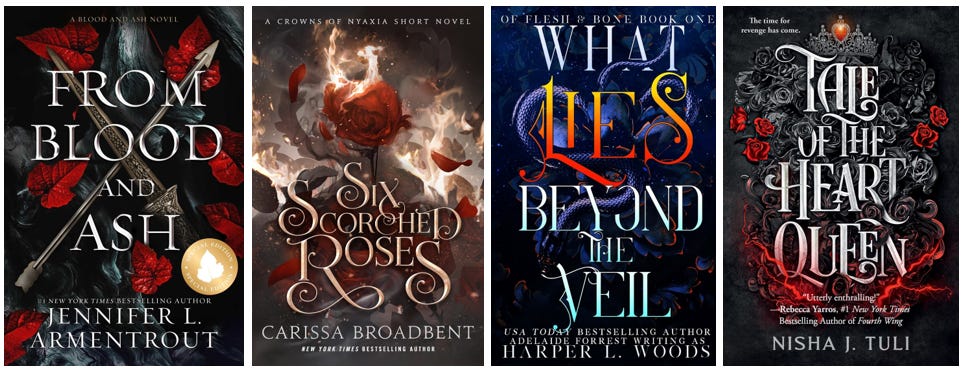
Comp titles are books that are comparable to the author’s. So for example, a debut satire novel written by a Black author might be comped to Erasure, by Percival Everett. I generally find that nonfiction comps are more accurate than fiction comps with regards to sales. I rely on those quite frequently when buying nonfiction debuts. But comp titles don’t matter to me that much with debut fiction. The titles publishers use as comps are fairly inflated in terms of sales. You can’t compare every slightly Southern novel with a mystery twist to the bestseller Where the Crawdads Sing. That’s a freakish wild outlier. The best comps are books with similar themes and sales that align with the publisher’s print runs. So a quiet, literary novel with a 10K print run should have comps that are quiet literary novels with 5-15K in sales. But something happens with fiction that just throws that calculus out the window. Every book the publisher is mildly excited about gets compared to the sales outliers like Lessons in Chemistry or James or Fourth Wing in the wild hopes that those comparisons will sell the books. Those comps can help me place the book thematically as far as what it is about, but they give me no information about how the book might sell. So I don’t use fiction comps to make my numbers decisions when it comes to debuts novels. I use print runs, publisher confidence, instinct, and whether or not I’ve seen 47 versions of the same book already that season. Please, publishers, I beg you, stop designing books this way.
For returning authors, the best indicator of whether or not I will buy a book is the author’s specific sales track at our store. I highlight those words because there are multiple bestselling authors that we don’t buy because our store has never sold any of their books. For whatever reason, our customers don’t buy them. The data that matters to me is what our specific customers have bought.
Authors with debut novels that had lackluster sales should not despair over this fact, because it is more nuanced than it appears. Let’s imagine a debut novelist wrote a book that didn’t meet the publisher’s sales expectations. That does not mean I will not bring the author’s next book into the store. If we sold even a single copy of their first book, I will still bring in their next book.
Things become tricky when we haven’t sold any copies of the author’s first book. If the book is a sequel, I skip it. We didn’t have a customer for the first book in the series, so we aren’t likely to get a customer for the second. If the book looks identical to the first book in theme, book premise, cover design, and publisher excitement, I skip it. But sometimes, I notice a change between the first book that didn’t sell in our store and the second book that still might. Sometimes the publisher makes that change evident and sometimes they don’t.
If the cover on the second book personally appeals to me, I give it more consideration than I normally would. (See above re: rabbits.) Cover design does matter. It’s the first thing customers see. It’s why you might see a different cover on a paperback book than a hardcover: the publisher was probably disappointed in the hardcover sales and wants to see if a different cover on the paperback will work more effectively to sell the book.
If the premise of the second book personally appeals to me, I am more likely to bring it in. But it also has the reverse effect: if the premise of the second book repels me, that’s a factor against it. For example, pregnancy freaks me all the way out, which I know is an internal bias I have to fight against, and I do. But if your second book has a huge pregnancy plot in it, that’s an unconscious mark I now have to work against. Meanwhile, put a medieval illumination of a cat on the cover and set your book in a fifteenth century abbey and I will immediately be intrigued. Buyers are idiosyncratic weirdos, and that can play out in our decision-making process if we aren’t conscious of it.
If the book is what I think of as “important” I will be more likely to bring it in. For example, we stock Ben Okri and Karen Tei Yamashita and Helen Dewitt, but their sales track in our store is spotty at best. We might sell two copies of one book and zero of the next. But I still bring all of them in, and I will keep stocking all of them even if none of them achieves commercial “success.” They all meet my personal definition of the kind of author we want to stock and give space to in our store. This is the best part about working in an independent bookstore. My opinion matters, and I have leeway from our owners to stock a select few authors who do not sell widely, simply because we want to keep supporting them and giving them a chance at being purchased at our store.
In turn, I trust the other staff members as well. If there is staff interest in the author’s second book, I will bring it in even if we sold none of the author’s first book. As I said before, staff picks sell books. If a staff member has an ARC and they are enjoying it, that’s more important to me than the author’s sales track.
And finally, I rely on what the sales rep from the publisher tells me. They know those sales numbers too, and they know they have to work against an author’s sales record to sell the second book. They will tell me if and why I need to take a risk on the second book by an author whose first book didn’t sell. Sometimes, they tell me to trust them and I do. Sometimes, they say things like, “ah, you didn’t buy this based on the author’s sales track…makes sense” and we move on. Other times, they point out key differences between the first and the second book, like short stories vs. novel, memoir vs. novel, genre changes, new editor, or even just that there is more “in-house buzz” for the second book. All of these things can make me buy a second book even when we haven’t sold the first one.
The unfortunate reality though, is that I very rarely take a third chance on an author unless it truly stands out or strikes me as important. Imagine I brought in six copies of your debut novel, and it sat in a prominent place in our store for a month, faced out on display (the best way to get customer notice for any book.) We sold zero copies. Then, your second novel came out. We bought one copy of it, because it looked interesting enough to me that I was willing to give your new book a chance. Our new fiction section is one of our most frequently perused sections, so that one copy can still catch a customer’s eye. But it also didn’t sell, and we returned it to the publisher. Then your third book comes out. (And yes, this still happens for plenty of authors, I literally see it all the time.) I look at the sales record in our specific store. I look to see how we have featured or not featured your titles in the past. And unless something really pops out to me, I don’t buy that third book for the store.
I’m not being cruel. Space is at a premium in the stores. There are too many books that come out every year, and I want to make sure we carry the best ones: important, meaningful, beautiful, good. But I also want to make sure we carry books that sell, so we can keep the lights on and pay our people. My decisions as a buyer are never solely commercially driven, but neither can I ignore commerce completely in favor of Art.
I do have a lot of sympathy for authors when I see the articles about publishers constantly taking risks on debuts and not giving the author more support for their second novels. Their support does matter, and as I’ve discussed, it can make me buy a book even after the author’s first book didn’t sell. But I can’t help but think that the problem is more complex than people might imagine. It’s not just that publishers place risky bets on a debuts in the hopes one of those bets hits big, it’s also that they place TOO MANY bets. The problem on my end is glut.
Fifty thousand new books a year in the United States alone? It sounds extreme, but I think that number should be halved. Maybe that is disheartening to authors or aspiring authors. But you don’t see the 50K books I see every year. And those are just traditionally published books. You don’t see how many look like the exact same book, down to their forgettable covers. You don’t see how many debuts of dragon romance there are, how many thinkpieces on AI, how many memoirs by the next en vogue marginalized identity (right now it’s Palestinian). It’s not dozens. It’s hundreds. (I’m looking at you dark fae romantasy). And the market can’t bear that many. It’s just not feasible. Even people who want to read every book on AI that comes out simply can’t. And that’s just one, single type of book. In a game with this many players, there will always be a lot of losers. I don’t have a solution to this. Publishers don’t (as far as I know) talk to each other about the types of books that they are putting on their lists every season and agree to only publish the best six books on ADHD. I’m pretty sure that’s collusion.
I read something a long time ago in some marketing book that contrary to prevailing opinion at the time, consumers buy more when they have fewer choices. More is not better. It’s just more. I think that’s why customers come into our store and tell me they like our vibe, or that we have a better selection than Barnes and Noble, which is maybe five or six times our size. Small stores have to curate.
I didn’t mention a final factor, and that is relationships. I am more likely to stock a book if an author has come into our store and said hello to us. Even if they aren’t local, even if we’ve never carried them before, even if their book hasn’t sold. An author who cares enough to say hello and identify themselves to us stands out. I can only speak for myself, not all buyers, not all stores, etc. And there are some differences between indie authors and traditionally published authors. (Some indie authors have an annoying habit of leaving bookmarks or flyers that link straight to Amazon. We literally trash those the second you leave.) So my best advice to authors is to visit independent bookstores, talk to the employees, actually shop there, and be friendly. We like to feel special to authors, and we will make you feel special in return.
I LOVED reading all of this! Thank you for writing about it! (also if you ever want to guest post on my Substack I would simply love to have you, talking about anything book industry related that strikes your fancy!!). I had to laugh at rabbits (*emails team to see if we can get a rabbit on my Next Summer Book*) (I jest)
This is such a good and thorough breakdown. Thank you for sharing!!